

I had the opportunity today to present my ideas and research plans with colleagues in the Scottish Advance HE Principal Fellow Network. I joined the network a few years ago after achieving my PFHEA for strategic leadership in academic development and when I was invited onto the network as all new PFs are, I was a little nervous and worried I would feel like an imposter. I started attending and was so glad that I did, it is always incredibly valuable and such a supportive group of colleagues, and I try to attend as many as I can. If you have your PFHEA and work in Scotland I would encourage you to go along, the network rotates different topics with presentations from colleagues in the network and the discussions are always so interesting and fruitful – even when not in your own direct areas of practice.
In the meetings we often spend time reflecting on identity and values, both professionally and personally so I started the presentation by sharing a little more about my journey, not to dissimilar to my first blog: My learning journey: from there to here – Alex Walker: Academic Learning and Development: you, me and my PhD
I spoke about Broc dog, obviously.

Broc dog
Tertiary education
I then moved onto sharing what I am exploring in the PhD and what I have been reading, discovering, and reflecting on around tertiary-ness. I shared some of what I had found and how that aligned to my own understanding, or lack of understanding around tertiary-ness and how it is defined or described. The presentation allowed us to go beyond what we already know, in particular that tertiary is generally accepted as being post compulsory education.
I explained that I ‘cast my net’ beyond the Scottish sector as I begin to draft the literature review and that some papers and opinion pieces had resonated with my own grappling with tertiary-ness and identity and importantly that learning takes places in many spaces outwith colleges and universities.

Image by chanwit whanset from Pixabay
Morris explores tertiary education in response to the possibility of the introduction of tertiary education reforms in England and states that “although the term tertiary education is being used with increasing frequency, the people proposing this way forward rarely define what they mean by the term” (Morris, 2024 p123).
This is also reflected by Hazelkorn (2023) who explores tertiary-ness through the lens of the Organisation for Economic Co-operation and Development (OECD) countries and states that many countries are reframing policy discussion around tertiary education but poses the question of “what is meant by a tertiary education system?” and ‘what do we want to achieve?’
Limb and Pheonix (2024) explore tertiary-ness in Britain in recent years in response to increasing policy focus on tertiary education, but claims… “What we are still lacking, however, is a clear consensus about what, exactly, tertiary education is…”
As I presented the chat space pinged with colleagues resonating with this quote particularly as in Scotland, we move into a tertiary space in quality and enhancement and in increasing areas of practice.
“Care needs to be taken that we are not simply engaged in ‘tertiary-washing’ – in other words, calling something tertiary which is really about university-level education”. (Hazelkorn, E. and Locke, W. 2023 p124)
I acknowledged that UHI although a tertiary institution has also grappled with tertiary-ness and drew attention to our position at UHI around tertiary education, highlighting a blog that was authored by the UHI Learning and Teaching Conference (2020) keynote speaker What do we mean by ‘tertiary’ and why does it matter
The areas that I explored inline with the keynote blog and the developments in Scotland since it was written were around:
- Quality and enhancement
- Funding
- Professional Standards
To explore quality and funding I drew attention to:
The Coherence and Sustainability: the SFC review of tertiary education and research (published June 2021), the SFC being tasked by Scottish Government Ministers to review tertiary education and research and make recommendations to ensure good quality and sustainable research and education in Scotland. We spoke how this review and the subsequent introduction of Scotland’s Tertiary Quality Enhancement Framework (TQEF) which was launched in colleges and universities in July 2024 was for many of us in the Scottish Education sector when we began to see a shift toward tertiary.
I spoke briefly about funding, through The Withers Review again commissioned by the Scottish Government in 2022 and published in June 2023 and the SFC response to the report recommendations to move toward a single funding body, bringing functions from the SFC (Scottish Funding Council), SDS (Skills Development Scotland) and, potentially, the SAAS (Student Awards Agency Scotland) together.”
I highlighted a paper that I have found useful in tying all these reports and reviews together and in considering tertiary education in Scotland, written by Derek Robertson (2025), who states:
“…an evolutionary and incremental rather than revolutionary approach towards greater integration of post-compulsory provision within Scotland.” (Robertson 2025:107)
Academic Practice Development
I then moved onto more familiar territory, exploring how through academic development and as a strategic leader, with the Academic Practice Development team and wider collaborators we aim to be tertiary in our development offering at UHI. This includes ensuring that what is being offered is informed by colleagues across our UHI Partnership. Some examples that include:
- UHI Staff Mentoring Scheme Advocates: amazing colleagues in the UHI Partner colleges that champion the mentoring scheme and support us to ensure that the scheme is appropriate and representative of the diversity of our staff body at UHI.

- Learning, Teaching and Student Experience conference organising group, for each conference we do we aim to have representatives across the UHI Partnership and the Higher and Island Student Association (HISA).
- UHI Staff Development Group set up in collaboration with UHI Inverness and UHI Perth and with representatives from across the partnership we meet bi-monthly to explore priorities for organisational and academic development and share opportunities and identify collaborative projects.
- LTA Connect Series: a long running lunchtime webinar series that shares good practice- with internal and external voices and using tertiary frameworks like the Student Learning Experience (SLE) model to celebrate practice at and beyond UHI in Further and Higher Education.
- Expanding professional recognition beyond Advance HE Fellowship and Awards to support colleagues to gain recognitions in learning technologies and hopefully (fingers crossed) in mentoring across FE and HE.
I highlighted how we support colleagues to consider how their professional development aligns with professional standards by mapping much of our offering to both the General Teaching Council for Scotland’s Standards for Lecturers in Scotland’s Colleges and the Advance HE Professional Standards Framework and the UHI Learning and Teaching Strategy Values which is tertiary strategy with 10 values that all students at UHI should experience at some stage of their learning at UHI.
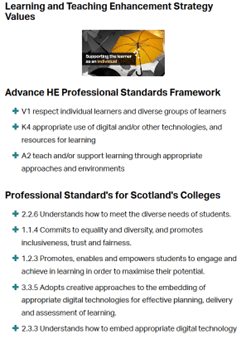
Professional Standards in a Tertiary Institution
I explored professional standards and the complexities of UHI engagement in both registration with the GTCS and with Advance HE Fellowships. I won’t explore that here because it largely is captured in my second blog: And so it begins…(officially): My PhD topic – Exploring the potential for an integrated set of professional standards for practitioners working in tertiary education contexts and institutions: a phenomenographic investigation – Alex Walker: Academic Learning and Development: you, me and my PhD
What concluded the meeting was wonderful conversations that explored the presentation themes and in particular tertiary-ness. Colleagues were generous with their suggestions and pointers on the research and I value everyone’s contributions.
As always colleagues in the network were warm, supportive and the discussions were rich and thought provoking. I look forward to the next one!
I have share my slides here.
Hazelkorn, E. and Locke, W. (2023) “Researching tertiary education ecosystems,” Policy Reviews in Higher Education, 7(2), pp. 123–126. Available at: https://doi.org/10.1080/23322969.2023.2235647.
Hazelkorn, E. 2023. “We Need a Dynamic New Model for Post-secondary Education.” University World News, 20thJune. https://www.universityworldnews.com/post.php?story=20230620120848977. Accessed 28 March 2026.
Limb & Phoenix. 2024. “What do we mean by tertiary education?”. Universities UK. https://www.universitiesuk.ac.uk/latest/insights-and-analysis/what-do-we-mean-tertiary-education. Accessed 15 May 2026
Morris, H. (2024) “What is meant by the term tertiary education? Past developments and recent activity,” Policy Reviews in Higher Education, 8(2), pp. 122–145. Available at: https://doi.org/10.1080/23322969.2024.2383602.
Robertson, D.J. (2025) “What is college education for? Institutional purpose in tertiary education in Scotland,” Policy Reviews in Higher Education, pp. 1–29. Available at: https://doi.org/10.1080/23322969.2025.2587954.


Leave a comment